
Born in 1902 in Clarendon County, Samuel Emory Rogers attended Washington and Lee University before earning his law degree at the University of North Carolina. He taught at colleges before returning to Summerton to practice law. His clients included the Clarendon County school system.
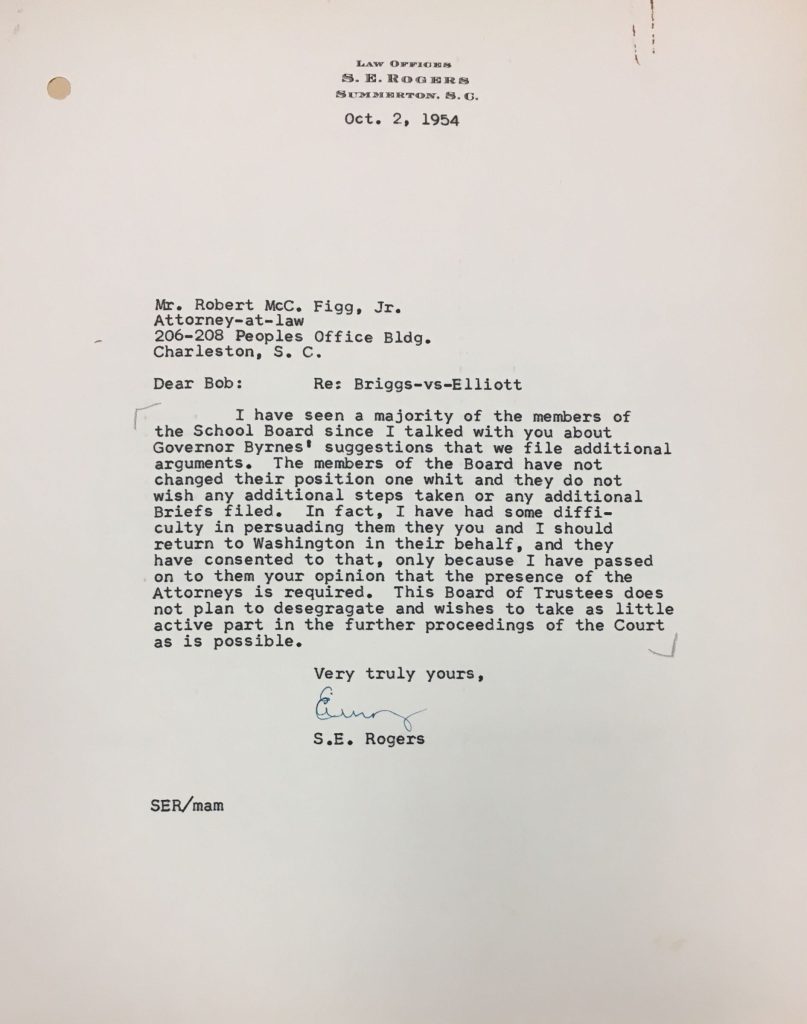
When Levi Pearson sued Clarendon County for buses for Black students, Rogers was the county’s lawyer. He continued to represent Clarendon County during the Briggs v. Elliott case, serving as lawyer for School District 22, the Summerton school district. Rogers worked closely with Robert M. Figg, a lawyer from Charleston who had been brought in to support the Clarendon County school system, and Attorney General T.C. Callison, who represented the state in federal district court in Charleston. Although Rogers did not argue the case before the United States Supreme Court in 1952 or 1953, he continued to work with the county and state.
Courtesy of Robert McCormick Figg, Jr. Papers, South Caroliniana Library
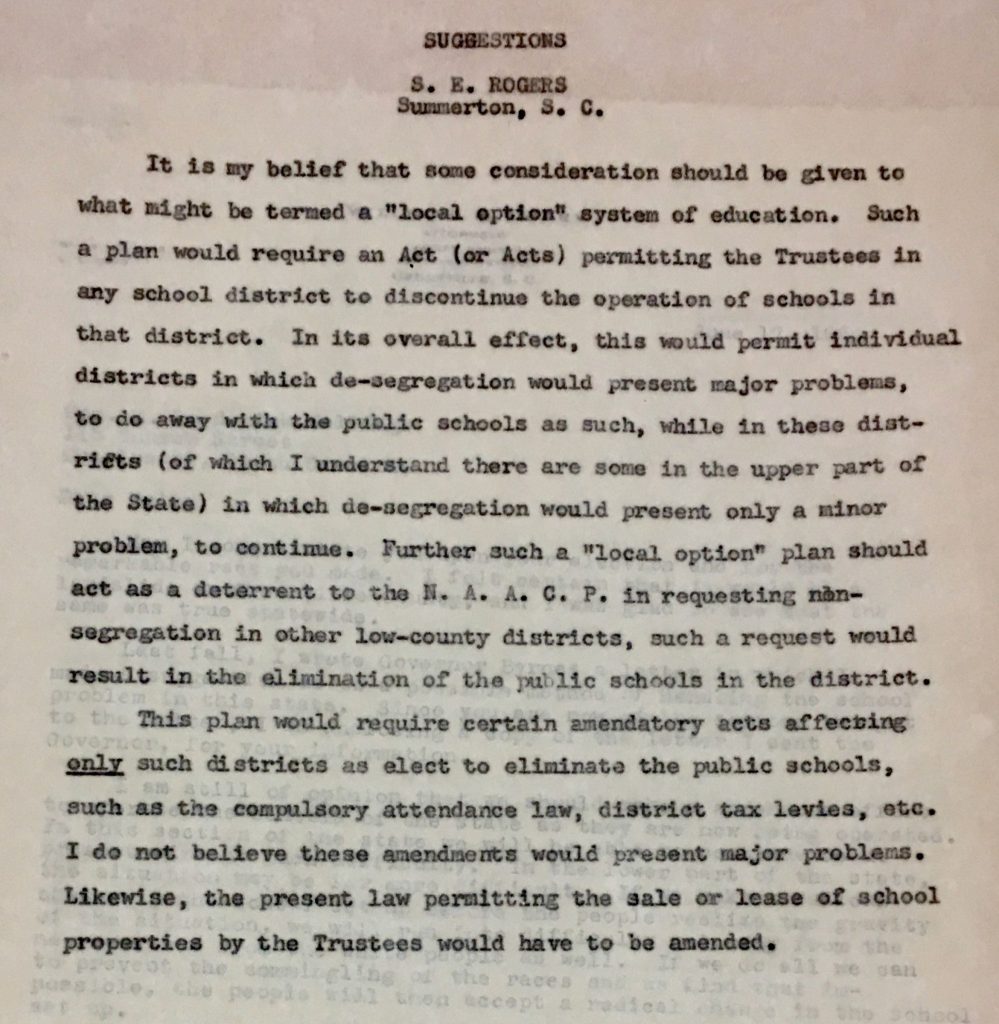
Following the 1954 decision in Brown v. Board of Education, Rogers worked with local and state officials to resist the court’s ruling, including advising Governor James Byrnes. He served as the Clarendon County counsel when they presented arguments in front of the Supreme Court the next year in the case of Brown v. Board of Education II, a continuation of the original Brown case that ruled schools had to desegregate “with all deliberate speed.”
Courtesy of South Carolina Political Collections
In the months after the Brown decision, white people across the South formed White Citizens’ Councils (WCC), with over 50,000 people joining in South Carolina in the first year. Rogers served as the state secretary for the WCC, which led retaliation campaigns against Black petitioners. This included cutting off credit to petitioners, getting them fired from their jobs, and keeping them from accessing farming equipment. Rogers also moved to have the WCC focus on limiting Black voting rights. He continued to advocate for segregated schools, even as schools across the country, and then the state, integrated. He said in an 1974 interview, “I still believe the things we were fighting for then.” Rogers died in 1976.